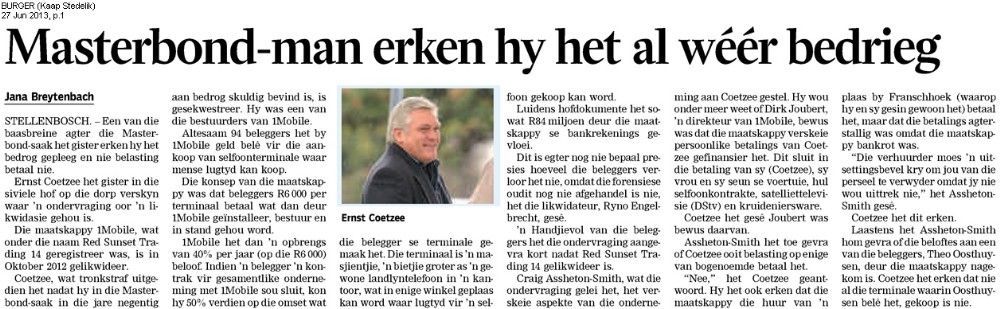
ASSHETON-SMITH INCORPORATED IN DIE BURGER 27 JUNE 2013
June 1, 2013

Masterbond-man erken dat hy al weer bedrieg


Translation:


Masterbond man once again admits that he committed fraud


Yesterday one of the masterminds behind the Masterbond case admitted to committing fraud and not paying tax.


Yesterday, Ernst Coetzee appeared in the Stellenbosch Civil Court where there was an enquiry held in relation to the affairs of 1Mobile.


The Company, 1 Mobile, which was registered under the name of Red Sunset Trading 14 (Pty) Ltd, was liquidated in October 2012.

Coetzee, who served a prison sentence after being found guilty of fraud in the Masterbond case in the 1990’s, was sequestrated. He was one of the managers of 1Mobile. A total of 94 investors invested money with 1Mobile for the purchasing of cellphone terminals which one would be able to purchase airtime from.


The concept of the Company was that the investors would pay R6000.00 per terminal which terminal would be installed, managed and maintained by 1Mobile.

1Mobile promised a return of 40% per year (on the R6000.00), if an investor was to conclude a joint venture agreement with 1Mobile, such investor would be able to earn 50% on the turnover which the investor’s terminal would generate.


The terminal is a small machine, just bigger than a regular office telephone landline, which can be installed in any shop where airtime for a cellphone can be purchased.


According to court documents approximately R84 000 000.00 flowed through the Company’s bank statements.


According to Ryno Engelbrecht, the liquidator of the Company, it still remains to be determined exactly how much money investors lost, since the forensic audit has not yet been completed.


Shortly after Red Sunset Trading 14 was liquidated, a handful of investors requested that an enquiry be conducted into the affairs of the Company.


Attorney Craig Assheton-Smith, who conducted the enquiry, put various aspects of the venture to Coetzee. He wanted to know, inter alia, about Dirk Joubert a director of 1Mobile, and if he was aware that the Company financed various payments of a personal nature to Mr Coetzee. Such payments included payments in relation to Coetzee’s wife- and son’s motor vehicles, their cell phone contracts, DSTV and groceries. Coetzee advised that Joubert had been aware of this.


Assheton-Smith further examined Coetzee as to if he ever paid any tax on the aforesaid payments.


“No”, Coetzee answered. He further admitted that the Company also paid for the rental; of a farm near Franschoek (were Coetzee and his family lived) but that these payments were in arrears because of the fact that the Company went into liquidation.


“The landlord had to get an eviction order to remove you from the premises because you did not want to move”, Assheton-Smith said. Coetzee admitted same.


Finally Assheton-Smith questioned him if any of the promises made to one of the investors, Theo Oosthysen, were fulfilled by the Company. Coetzee admitted that not all the monies Oosthyzen had invested were allocated to buying terminals.

November 13, 2025
ASG Lawyers honoured in The Best Lawyers in South Africa (2026) The directors and team at Assheton-Smith Ginsberg Inc. (ASG) are proud to announce that three of our lawyers have been recognised in The Best Lawyers in South Africa (2026) — an accolade based entirely on peer review and widely regarded as one of the most respected honours in the legal profession. Celebrating our recognised lawyers Craig Assheton-Smith , Director, has once again been acknowledged for his excellence in both Litigation and Insolvency and Reorganization Law. This marks his 15th consecutive year being recognised for Litigation — a testament to his unwavering commitment to clients, his strategic approach to complex disputes, and his respected standing among peers. Andrew Ginsberg, Director, has been recognised f or Arbitration and Mediation as well as Litigation , continuing a six-year streak of consecutive recognition in both categories. Andrew’s ability to navigate high-stakes disputes has earned him a reputation as a leading dispute resolution practitioner. Anne Venter, Director, has achieved her first recognition in The Best Lawyers in South Africa (2026) for Insolvency and Reorganization Law and Litigation. This honour highlights her growing impact and expertise in these challenging and dynamic areas of law. Recognition that reflects outstanding legal practice Each year, Best Lawyers identifies the top legal talent across jurisdictions through an exhaustive peer-review process. Lawyers are nominated and evaluated by their professional peers, ensuring that recognition is based solely on the quality of legal practice and ethical standards — not submissions or sponsorships. Learn more about the process at https://www.bestlawyers.com/article/legal-industry-secret-behind-best-lawyers/6602 This recognition reflects not only the individual achievements of Craig, Andrew, and Anne but also the collective strength of the ASG team. It is a reaffirmation of our continued focus on excellence, integrity, and client-centred service in every matter we undertake. Continuing the tradition of excellence At ASG, we view such recognition not as an endpoint, but as encouragement to continue setting the standard for litigation and dispute resolution in South Africa. We congratulate our colleagues on these well-deserved honours and thank our clients and peers for their ongoing trust and recognition.
February 19, 2024
Client Background: Client Profile: Our Client, a Dutch Shipbuilder and his companies, owns and manages a shipyard as the second generation of the family that started the shipyard. The shipyard is one of the oldest shipyards in the Netherlands. The business, situated in Sliedrecht in the southwest of Holland, began as a small shipyard offering general repairs and maintenance services to various shipping companies and has expanded to a large shipyard over 90 years with two floating docks and offering in addition to repairs and maintenance, conversion, construction, and design of new parts for ships. Challenges Faced: In mid-2009, 12 barges, a pontoon and two halves of floating dock that the Dutch Shipbuilder and his companies had ordered the construction of in China, were stranded at JacobsBaai on the West Coast of South Africa and were lost. This loss arose from the tugboat operator and owner’s negligence in towing these items from China to Rotterdam. The Dutch Shipbuilder had arranged financing from his bank for the purchase of these items. His bank assisted him with the negotiation of the contracts for the construction, the arrangement of insurance, as well as the final arrangements for the towing of the constructed items from China to Rotterdam, representing themselves as experts in doing so. The Dutch Shipbuilder completely trusted his bank with whom he had a relationship for numerous years. Given the bank’s failure to inter alia put proper insurance in place, a settlement agreement was then concluded between the Dutch Shipbuilder and his companies, and his bank, following the calamity, in which the bank agreed to assist him in pursuing an action in South Africa against the tug-boat operator and owner to recover the loss. The key component of the items constructed was the two halves of a floating dock, which was destined to be moored and operated in Sliedrecht Holland to expand the operations of the shipyard, which was fully supported by the local, regional and state authorities. Action was instituted against the tugboat operator and owner for damages in an amount of €42 million, which included a claim for loss of profits suffered from the loss of the two halves of the floating dock. By the beginning of 2015, some 6 years later, the attorneys who had been appointed by the Dutch Shipbuilder had not progressed the action to a point where it was ready to go to trial. ASG was approached by the Dutch Shipbuilder to take over the case from the existing attorneys. ASG took over the case in May 2015, and the action was settled in September 2016. The Problem: Legal Issues: What did not form part of the settlement was the loss of profit claim in respect of the two halves of the floating dock as the bank refused to assist the Dutch Shipbuilder in providing evidence that he had applied for finance to order a replacement of the two halves of the floating dock to mitigate his loss. However, the Dutch Shipbuilder had indeed done so and, as such, the bank’s refusal to assist him breached its obligation to do so in terms of the settlement agreement and its duty of care as banker to its customer in terms of the Dutch laws. In 2017, on advice from ASG the Dutch Shipbuilder agreed to pursue his bank for damages arising from their breach of the settlement agreement in the Dutch Courts. ASG was instructed to formulate the claim and work with Dutch advocates to do so. The amount claimed from the bankers was €10,609,527 alternatively, €6,293,046. The Dutch Shipbuilder’s bankers raised a counterclaim of €2.75 million plus interest and costs claiming that it was entitled to be paid this amount in terms of the settlement agreement it had concluded with the Dutch Shipbuilder and his companies. In 2018, the Dutch Shipbuilder and his companies were ordered to pay €2.75 million plus interest and costs in terms of judgments of the Central Netherland District Court Utrecht. Impact: The many years of legal proceedings in South Africa, without support from the bank who had undertaken to provide the financial support for the proceedings, had taken a major toll on the Dutch Shipbuilder both financially and personally. The Dutch Shipbuilder, now diagnosed with cancer, and his wife who had supported much of his legal costs financially, were determined that ASG should appeal the judgment to preserve what little relief to their financial loss the settlement in the tugboat operator case in South Africa had brought. Our Approach: Strategic Analysis: ASG knew that to win an appeal, they would need one of the senior employees of the bank to confirm that there was an agreement by the bank to fund the litigation in South Africa to recover the cost and loss of income incurred by the shipyard from the tugboat owner. Solution: Through thorough investigation and unearthing vital correspondence, it was discovered that a former senior employee of the bank that had been approached previously to provide a witness statement, was willing to do so, as the Dutch shipbuilder had in fact approached him to seek financing to procure a replacement floating dock. He had been prepared to provide a witness statement previously, but had been forbidden by the bank to do so. Execution: Legal Actions Taken: Subsequently in 2018 notification was given of an appeal being raised. This was followed by witness hearings in November 2019 and in January 2020. The evidence given by witnesses at the witness hearings provided vital evidence to establish that the bank had indeed prevented evidence being provided with regard to the assistance for the Dutch shipbuilder in the South African proceedings, and that the bank had also lied to the court in Utrecht.  Pleadings were then filed in the appeal to deal with the merits of the appeal and not the quantum of the claim. Results Achieved: At the hearing, the judges of appeal expressed their disapproval of the way in which the bank had conducted itself and suggested the parties attempt to reach a settlement. A settlement agreement was concluded in terms of which the bank agreed to waive its claim against the Dutch Shipbuilder and his companies in full and final settlement. Sadly, the Dutch Shipbuilder had passed away before the outcome of the appeal. May he rest in peace as he was much loved by all who came across him.